Search (Vyhledávání)

Showing posts with label Revoluce dinosaurů (Dinosaur revolution). Show all posts

Thursday, March 7, 2013

Revoluce dinosaurů (Dinosaur revolution)


(English version at the end of the article)

Naše znalosti o dinosaurech se za poslední léta v mnohém změnily. Ukázalo se, že to, co jsme si o jejich životě mysleli před 20 lety, bylo téměř všechno špatně. S vědeckým pokrokem se stále více vynořuje na povrch nová a až neuvěřitelně překvapivá tvář vládců druhohor. Evoluce dinosaurů se ubírala podivuhodnými směry od prapodivných morfologických struktur až po složité sociální chování a ve vědeckém světě zcela právem probíhá skutečná revoluce v pohledu na tyto tvory. 


Morfologické změny během ontogeneze klíčem k pestrému sociálnímu životu


Diverzita dinosaurů sahá od drobných forem velikých jako kočka až po opravdové giganty s mnohatunovou hmotností. V minulosti byla pozornost paleontologů věnována především pokusům o nalezení obrovských kosterních pozůstatků a muzea se předháněla v tom, které z nich vlastní větší exemplář. Když ale došlo na otázku, kde jsou mladé exempláře dinosaurů, odpověď prostě zněla, že neexistují. Všeobecně se předpokládalo, že mláďata vypadala jako zmenšené kopie svých rodičů, jak je tomu u dnešních plazů. Díky práci jednoho z nejúspěšnějších paleontologů posledních desetiletí, Jacku Hornerovi, se ale tato představa začala bortit. Ukazuje se, že dinosauři byly ve způsobu růstu podobní spíše ptákům.

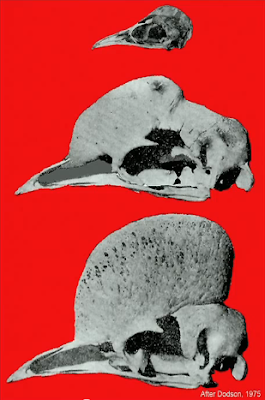
Novátorská myšlenka, že dinosauři možná rostli alometricky, Hornera napadla v jeho muzeu s názvem Museum of the Rockies během zkoumání lebek tří druhů pachycephalosaurů (Pachycephalosauria), dinosaurů s tlustou lebkou. Jednalo se o druhy Dracorex hogwartsia, Stygimoloch spinifer a Pachycephalosaurus wyomingensis. První z nich dosahuje nejmenšího vzrůstu a na zadní straně tlusté lebeční báze mu vyrůstají dlouhé kostěné výběžky. U druhého zvířete je velikost větší a útvary menší, zatímco třetí je naprosto postrádá a jeho lebeční báze je mnohem tlustší. Stavba lebky pachycephalosauridů s mohutnou frontoparietální zónou je mezi obratlovci naprosto unikátní. Bylo už publikováno mnoho prací zabývajících se funkcí této morfologické struktury, ale téměř žádná pozornost nebyla věnována jejím změnám během ontogeneze. 


Horner si jednotlivé charakteristické morfologické struktury na lebkách všech tří druhů vyznačil jako landmarky a ukázalo se, že se ve skutečnosti jedná o tři ontogenetická stádia jednoho druhu. Dlouhé výběžky a absence zvětšené frontoparietální zóny charakterizují nejmladší jedince popsané původně jako druh Dracorex hogwartsia. Postupně s růstem dinosaura dochází ke vtlačování výběžků do lebeční báze až do stádia kostěných pupenů. Zároveň se ztlušťuje svrchní část lebky. Hypotéza byla podpořena také histologickou analýzou kostí vykonanou po jejich příčném rozřezání. Lebeční kosti mladého jedince mají pórovitou strukturu se silnou vaskularizací pro účel rychlého růstu, naopak u dospělců nalezneme velice denzní strukturu s Haversovými kanálky bez silné vaskularizace. Všechno zapadalo do skládanky – Dracorex je mládě, Stygimoloch subadult a Pachycephalosaurus dospělec. U druhého stádia byl dokonce objeven také intrafrontální šev, který zaniká až po srůstu frontálií v období, kdy jedinec dosáhne dospělosti. Ze tří druhů pachycephalosaurů se najednou stal jeden.


To ale nebylo zdaleka všechno. Dlouholeté zkušenosti s hledáním fosílií ve slavné americké geologické formaci Hell Creek přivedly Jacka Hornera na stopu dalšího omylu v paleontologii. Zaměřil se na hledání mláďat jednoho z nejlépe známých dinosaurů –Triceratops horridus. Patří k ceratopsidům, rohatým dinosaurům, kteří v období Křídy ve velkých počtech obývali především severní polokouli. Triceratops je znám více než sto let a za tuto dobu byly popsány jen 4 lebky nepatřící adultům. Jak se ale ukázalo, důvodem byla jenom skutečnost, že hledání mláďat nebyla věnována dostatečná pozornost. Horner díky své práci během krátkého časového období objevil několik lebek mláďat různého věku, které pak mohly být vzájemně srovnány. Poprvé v historii se dalo zkoumat, jak se měnila morfologie Triceratopse během jeho života. 


Do výsledné analýzy vstoupilo 10 lebek od délky 38 cm až po 2 metry a byla nalezena až šokující alometrie v rámci 4 růstových stádií. Hlava mláděte připomíná svým celkovým vzezřením proporce lebek juvenilních jedinců dnešních zvířat (veliké oči, krátká lebka, redukované znaky adultů). Límec tvořený kostmi  os parietale a os squamosum je plochý a s věkem se postupně prodlužuje a rozšiřuje. U mláďat se na jeho obvodu nacházejí epoccipitalia, kostěné výběžky, které se s přibývajícím věkem zanořují zpátky podobně jako výběžky mladých jedinců u Pachycephalosaurů. Také postorbitální rohy procházejí mohutnou proměnou. Nejmladší jedinci mají jen malé základy rohů, které se u subadultů prodlužují a posteriorně ohýbají. Až v dospělosti dojde k jejich narovnání a konečnému zahnutí anteriorně. U mláďat odděluje kost os supraoccipitale od sebe dvě kosti os exooccipitale a tvoří střechu mozkovny a otvoru foramen magnum. U subadultů se přesouvá postupně dál a u dospělců už je kompletně oddělena od foramen magnum a překrývá exooccipitália. Dalším důležitým znakem dospělých jedinců je podle Hornera vytvoření parietálních oken v kostěném límci. U Triceratopse nebyly zatím tyto okna prokázány. Návrh na zrušení platnosti dalšího druhu dinosaura na sebe nenechal dlouho čekat. Tentokráte se jedná o druh Torosaurus latus, od kterého byly doposud známé jenom pozůstatky dospělců s otvory na kostech tvořících límec. Po důkladném zkoumání lebek vyšlo najevo, že čím starší jedinec byl, tím měl tenčí os parietale v místech, kde se u Torosaura nacházejí již zmíněné otvory. Horner teď mohl prokázat, že Torosaurus ve skutečnosti představuje dospělého Triceratopse s plně vyvinutou hustou kostí bez silné vaskularizace a s Haversovými kanálky. Po odebrání vzorků z postorbitálních rohů byla u nově popsaných stádií opět nalezena struktura typická pro juvenily, naopak stádium Torosaura mělo jednoznačně strukturu typickou pro dospělce. Jeho práce tedy vedla k návrhu nechat „vyhynout“ už tři druhy dinosaurů. 


Na základě nových poznatků můžeme očekávat revoluční změny našeho pohledu na ontogenezi dinosaurů i u dalších druhů. Předpokládá se dokonce, že možná až jedna třetina všech popsaných druhů ve skutečnosti představuje určitá ontogenetická stádia druhů jiných. Fascinujícím příkladem je případ Tyrannosaura rexe, nejobávanějšího a nejznámějšího dinosaura. Podobně jako u Triceratopse byly i u tohoto druhu po dlouhou dobu vzácností fosilní zbytky mláďat. V Cleveland Museum of Natural History je ale uložena lebka, která budí mnohé pochybnosti a byla základem pro Hornerovu hypotézu o zrušení validity dalšího druhu dinosaura. Oficiálně patří druhu Nanotyrannus lancensis, což je drobný a štíhlý bratranec obávaného Tyrannosaura. V důsledku předchozích objevů u pachycephalosaurů a Triceratopse se ale na scéně objevila otázka, jestli se ve skutečnosti nejedná o mladého jedince mnohem většího predátora. V jedné ze svých předchozích studií Horner pomocí osvědčené techniky zkoumání histologie kostí zjistil, že Tyrannosaurus rex rostl přibližně stejným tempem jako dnešní slon africký (Tyrannosaurus dosáhl dospělosti ve věku 20 let a slon ve věku 25 let). Znamená to tedy, že mladá zvířata pravděpodobně vedla velice aktivní život a morfologicky se v mnohém od dospělců lišila. 


Názory na lebku uloženou v Clevelandském muzeu se doposud rozcházejí a je považována buď za mládě Tyrannosaura rexe, nebo za Nanotyranna. Jedním z hlavních argumentů proti první hypotéze je skutečnost, že zatímco menší z tyrannosaurů má v čelisti 17 zubů, ten nejmohutnější jenom 12 až 13. Je skutečně možné, že dinosauři během dospívání přicházeli o zuby? Jacku Hornerovi se povedlo něco podobného, jako u případu s rohatým Triceratopsem – našel během jedné sezony až 5 lebek obávaného predátora období Křídy, a navíc mezi nimi byla jedna výjimečná. Je větší než lebka Nanotyranna a menší než lebka dospělého Tyrannosaura rexe. V čelisti má 14 zubů, což je podle něj jasný důkaz, že tyrannosauři přicházeli s věkem o zuby a že zrušení platnosti dalšího druhu dinosaura je opodstatněné. Po srovnání lebek navíc vyšlo najevo, že u dospělců docházelo k vytvoření hrbolků na svrchních kostech horní čelisti a silnému zhrubnutí os postorbitale, což byly pravděpodobně jasné znaky sexuální zralosti. Jeden z největších predátorů v historii naší planety tedy započal svůj růst jako drobný subtilní lovec malých živočichů, který se od dospělců morfologicky velmi lišil.

Ne všichni odborníci se shodují v názorech na nové vnímání ontogeneze dinosaurů a případné rušení dříve popsaných druhů. Navržené zrušení validity Torosaura například vyvolalo zapálené reakce dalších paleontologů a vlnu nespokojenosti i v řadách laiků, navíc situace není doposud uzavřena. Důkazů pro existenci bizarních transformací ale pořád přibývá. Jednou z dalších skupin dinosaurů s ohromnou diverzitou různých kostěných útvarů, které vznikly patrně jako výsledek sexuální selekce, jsou hadrosauři. V budoucnu dojde nejspíš právě u těchto sociálních býložravců ke zrušení platnosti několika druhů. Zatím se pozornost věnuje především kraniální anatomii, ale studium postkraniálních částí kostry může odhalit další překvapivé informace o tom, jak dinosauři rostli. Je velice pravděpodobné, že většina dinosaurů během svého růstu procházela několika ontogenetickými stádii. 


K jakému účelu ale sloužila existence z energetického hlediska nákladných morfologických struktur? Odpověď je prostá – k sociálnímu životu. Pro studium evoluce chování dinosaurů nám nejlépe poslouží ptáci, jejich přímí potomci. Jak bylo experimentálně zjištěno, nalezneme u nich pořád geny zodpovědné za tvorbu zubů nebo ocasu, jejichž exprese je pouze potlačena v důsledku evolučních adaptací. Podobně jako dinosauři, i mnozí ptáci disponují morfologickými strukturami, které jim pomáhají komunikovat mezi sebou v rámci societ. Tyto struktury se navíc s věkem vyvíjejí. Příkladem můžou být kasuáři nebo zoborožci, u kterých si mláďata až do poměrně pozdního věku uchovávají juvenilní znaky. Říkají: „Jsem mládě, ne hrozba.“ Naopak jedinec nesoucí znaky dospělce může představovat soka, nebo naopak sexuálního partnera. Různé morfologické struktury byly pravděpodobně podobně jako u ptáků pestře zbarveny a doplňovaly složitou mozaiku jejich sociálního chování.


Our knowledge of dinosaurs have differed a lot in the last few decades. It became clear, that almost everything we thought about them 20 years ago is wrong. The new and surprising face of kings of Mesozoic period is coming up. The evolution of dinosaurs went through the extraordinary paths from stunning morphological structures to the complex social behaviour. We live in the age of new dinosaur revolution.


The morphological changes during ontogeny as the key to the variable social life

The dinosaur diversity reaches a huge scale from the tiny ones in the size of a cat to the true giants with weight of tons. In the past the strongest attention was focused on searching for the biggest fossils and museum were competitors in possesing as huge bones as possible. But when it came to the question of juveniles, almost everybody assumed that they don't exist. The overall theory was, that youngsters looked as the smaller copies of their parents, same as in recent reptiles. Thanks to the work of one of the most successful paleontologists in last decades, Jack Horner, this opinion about dinosaur ontogeny started to fall apart. It appears, that dinosaur grew up a lot more similarly to birds.


The new idea, that dinosaurs grew with allometric speed, came to Horner in the Museum of Rockies during examination of skull of three species of pachycephalosaurs (Pachycephalosauria). These were Dracorex hogwartsia, Stygimoloch spinifer and Pachycephalosaurus wyomingensis. The first one is the smallest and on the posterior part of thick skull base it has a prominent bone thorns. The second species is bigger and its thorns are smaller, the third one completely lacks them and the skul base is much stronger. The skull morphology of pachycephalosaurs with the robust frontoparietal zone is unique in vertebrates. Many studies were published on the function of these structures, but almost no attention was focused on their ontogeny. 


Horner highlighted the characteristic structures on skull as landmarks and it showed out, that they represent a three ontogenetic stages of one species. The long horns and the absence of enlarged frontoparietal zone are characteristic for the youngest individuals described originally as Dracorex hogwartsia. During growth the horn are getting back into the main bone and they end as pyramidal nodes. The upper part of skull base is getting thicker. The hypothesis was also supported by the histological analysis of bones done after their transversal cutting. The skull bones of young individual have a porous structure with the strong vaskularization for the quick growth, in adults we find a very dense structure with the Haversian tissue and without stronger vaskularization. Everything matched into the puzzle - Dracorex is a youngster, Stygimoloch is a subadult and Pachycephalosaurus is and adult animal. In the second one, even the intrafrontal suture was found, which dissapears after the connection of frontalia and indicates a stage of growth in young individuals. From three species of pachycephalosaurs there was suddenly only one.


But this was not the end. The long lasting experiences with the hunting of fossils led Jack Horner to the next mistake of paleontology. He focused on the one of the best known dinosaurs -Triceratops horridus. It belongs to ceratopsians, the horny dinosaurs mainly from the northern hemisphere of Cretaceous. Triceratops is known more than 100 years and only 4 skull of young animals have been described ever since. However, as it became clear, this was caused only by the small attention focused on searching for small skulls. Horner found a few skull in the short period of time and they could be compared together. For the first time in the history the ontogeny of Triceratops could be examined. 


10 skull reaching from 38 cm to 2 meters were included in the analysis and there was a shocking allometry found in the 4 growth stages. The head of young animal resembles the proportions of recent juveniles in animal kingdom (big eyes, short skull, reduced adult features). Frill build from os parietale and os squamosum is flat and during ontogeny it becomes longer and wider. There are epoccipitals (bony elements) at the edge of the frill in youngsters and they are gradually reduced and get smaller into the main bone as in young Pachycephalosaurs. Also the postorbital horns go through a big changes. The smaller ones have only the base of horns, which get longer and in subadults they curve posteriorly. After reaching adulthood they go straight again, but finally they curve anteriorly. In juveniles, os supraoccipitale separates two bones os exooccipitale from each other and forms a roof for the braincase and foramen magnum. In subadults it moves back and in adults it is completely separated from foramen magnum and is over exooccipitals. The next key feature of adults is according to Horner creating of parietal fenestra in the frill. In Triceratops, no parietal fenestra were found before. But the suggest for canceling another valid dinosaur species was just waiting. This case is about Torosaurus latus, which is known only from adult with such fenestra in their frill. After the complex examination of frill found by Horner it became clear, that the more old the animal the more thin the frill was in the place of os parietale. Horner could prove, that in fact Torosaurus is an adult Triceratops with the fully developed bone without strong vaskularization and Haversian tissue. It was proved after the examination of fragments of postorbital horns from recently discovered ontogenetic stages, where the bone structure matched for juveniles. In Torosaurus skulls the bone was typical for adult animal. Thus, the work of Jack Horner led to proposal to cancel 3 species of dinosaurs. 


According to the new findings we can expect revolutionary changes in our point of view on dinosaur ontogeny. It is even assumed, that almost one third of dinosaur species in fact represent ontogenetic stages of one different ones. A fascinating example happened in the case of Tyrannosaurus rex, the most fearsome and best known dinosaur. Similarly to Triceratops, the fossils of juveniles were very rare in the past. But in Cleveland Museum of Natural History is one skull, which triggered doubts about existence of another dinosaur species and was a basestone for Horner and his hypothesis. Oficially it belongs to Nanotyrannus lancensis, a smaller and faster cousin of Tyrannosaurus. After the discoveries in pachycephalosaurs and Triceratops, question about juveniles of huge predator emmerged. In one of his previous studies Horner proved, that Tyrannosaurus rex grew in a similar speed to african elephant (Tyrannosaurus reached adulthood in 20 and elephant in 25 years). It basically means, that young animals probably led a very active life and their morphology was very different from adults.


Two hypotheses about classification of skull from Cleveland museum assign it to young Tyrannosaurus rex or Nanotyrannus. The main argument against the first one is the fact, that the smaller dinosaur has 17 teeth in the jaw, the bigger one only 13 or 12. Is it really possible, that dinosaur have lost their teeth during ontogeny? Jack Horner succeded in the same project as with Triceratops -he had found 5 skull in one season. And one of them was very unique. It is bigger than skull of Nanotyrannus and smaller than skull of adult Tyrannosaurus. It has 14 teeth in the jaw, which is a clear evidence for Horner, that tyrannosaurs have lost their teeth when growing and the suggestion of canceling a validity of another dinosaur species is correct. After the comparation of skull it appeared, that in adults there were protuberances on the upper bones of skull and a thickening of os postorbitale happened, which is probably a signal of sexual maturity. One of the biggest predators in the planet's history started its life as a small and subtle hunter of small animals, very different from adults.


Not all experts agree with Horner in his opinion about dinosaur ontogeny and canceling of some species validity. The proposal to let Torosaurus go extinct started a passionate reactions and dissagreement in scientific and also public audience and the case is still not solved. But the number of proofs for the bizarre transformations in dinosaurs is increasing. One of the groups of dinosaurs with a massive diversity of bony structures, probably as a result of sexual selection, are hadrosaurs. In the future, these herbivors can be the next target for lumping of several species. Today, the biggest part of attention is dedicated to cranial anatomy, but examination of postcranial skeleton can also be very helpful. It is very probable, that most of dinosaur species reached several ontogenetic stages during their lifes. 


But for what reason should exist the energetically costly morphological structures? The answer is simple -for the complex social life. To study dinosaur behaviour, we have to focus on their direct descendants, birds. There were exmeriments, which proved that genes responsible for the growth of teeth or tail vertebrae are still present in birds, their expression is just supressed because of other evolutionary adaptations. Similarly to dinosaurs, birds have many structures, which help them to communicate with each other. And finally, these are developing during ontogeny. The good example can be cassowaries aor hornbills. Their chicks retain the juvenile look for the long time and this basically sais „I am a juvenile, not a threat.“ On the other hand, adult features and structures are signals of enemy or sexual mate. These morphological structures were probably also very colourful in dinosaurs and were part of the living in societes. 


Zdroje:

HORNER J. R. & GOODWIN M. B. 2009: Extreme Cranial Ontogeny in the Upper Cretaceous Dinosaur Pachycephalosaurus. PLoS ONE 4(10): e7626. doi:10.1371/journal.pone.0007626.

HORNER J. R. & GOODWIN M. B. 2006: Major cranial changes during Triceratops ontogeny, Proc. R. Soc. B 7 (273): 2757-2761. doi: 10.1098/rspb.2006.3643.

SCANNELLA J. B. & Horner J. R. 2010: Torosaurus Marsh, 1891, is Triceratops Marsh, 1889 (Ceratopsidae: Chasmosaurinae): synonymy through ontogeny, Journal of Vertebrate Paleontology 30 (4): 1157–1168.

WITMER L. & M. RIDGELY R. C. 2010: The Cleveland tyrannosaur skull (Nanotyrannus or Tyrannosaurus): new findings based on CT scanning, with special reference to the braincase, Kirtlandia, 57:61–81.

HORNER J. R. & PADIAN K. 2004: Age and growth dynamics of Tyrannosaurus rex, Proc Biol Sci., 271(1551): 1875–1880.


Monday, January 14, 2013

Revoluce dinosaurů (Dinosaur revolution)

První dinosauři

(English version at the end of the article)

Nejstarší dinosauři byli bipední a rychlí tvorové, kteří bojovali o své místo v ekosystémech prakontinentu Pangea s mnoha protivníky. Ve středním triasu už nalezneme druhy, které je možné zařadit do skupin Saurischia (Herrerasaurus, Eoraptor) a Ornithischia (Pisanosaurus). Objevy začaly na konci dvacátého století v argentinské provincii Ischigualasto, kde byly nalezeny pozůstatky druhů Herrerasaurus ischigualastensis a Eoraptor lunensis. Zatímco čeleď Herrerasauridae byla považována za sesterský taxon k Neotheropoda, Eoraptor vešel do povědomí jako nejbazálnější theropod. Apomorfních znaků pojících kostru těchto dinosaurů k theropodům je mnoho, například široká intercentra obratlů, prodloužený humerus a manus, plochý čtvrtý metakarpál nebo kraniomandibulární a intramandibulární kloub na stejné úrovni jako řady zubů. Později došlo k nálezům dalších bazálních dinosaurů, což vedlo k novým hypotézám o rané fylogenezi této skupiny. Saturnalia tupiniquim byla například vyhodnocena jako bazální sauropodomorf s alternativní pozicí rodů Herrerasaurus a Staurikosaurus jako bazálních saurischianů k dichotomii Theropoda+Sauropodomorpha, nebo jako monofylum sesterské k Dinosauria. Herrerasauridi jsou podle novějších studií sesterskou skupinou k Eusaurischia (všechny ostatní klady v rámci Saurischia) a postrádají některé apomorfie této skupiny. Po přidání nových nálezů se tato problematika ukázala jako složitá a dodnes zůstává například pozice herrerasauridů nebo Eoraptora nejasná. Je to způsobeno především rozdílnou metodologií u studií a jinou váhou přikládanou jednotlivým morfologickým znakům (Sereno, 2007). Přinejmenším ale víme, že ve středním triasu došlo k diverzifikaci saurischianů do theropodů a sauropodomorfů. Za bazálního ornitischiana je považován Pisanosaurus mertii z období před zhruba 225 miliony let. Kdysi bylo zpochybněno, že se jedná o jedno zvíře v důsledku absence synapomorfií s Ornitischia. Zdá se, že ornitischiani nebyli v triasu příliš diverzifikováni a nedostatek nálezů nechává prostor pro alternativní hypotézy o sesterské skupině k heterodontosauridům (například Silesaurus opolensis). 

Dentice bazálních dinosaurů se velice brzo specializovala na způsob získávání jejich potravy. Výchozím typem byl pravděpodobně chrup karnivorních thekodontů a zdá se, že i u druhů, kde dentice nevypadá příliš specializovaně, byl určitý podíl masité potravy (Eoraptor, Saturnalia). Zdá se tedy, že pleziomorfním znakem je omnivorie. V případě monofyletického původu dinosaurů je pravděpodobné, že první zástupci byli všichni bipední (zatím chybí dostatek informací o sauropodomorfech). U sauropodomorfů mohla být bipední chůze jen fakultativní (Silesaurus opolensis), naopak theropodi a ornitischiani na začátku své evoluce kvadrupední určitě nebyli. Zdá se, že už bazální dinosauři měli určitý tělesný pokryv (protopeří), což naznačil objev druhu Tianyulong confuciusi z Číny z doby před zhruba 160 miliony let.

Vybrané znaky na kostře Herrerasaurus ischigualastensis, podtženy jsou apomorfie sdílené s Neotheropoda, ostatní jsou plesiomorfní vzhledem k Eusaurischia (hvězdička je u znaků sdílených s bazálními ornitischiany)
Rekonstrukce lebek bazálních zástupců theropodů a býložravců (zde neplatné označení Phytodinosauria)
V roce 2011 byl publikován článek o novém nálezu z argentinské provincie Ischigualasto -dostal název Eodromaeus murphi. Srovnání morfologie s Eoraptorem dovedlo autory k zajímavému závěru. Zatímco nový dinosaurus je bazálním theropodem  s těmito typickými znaky: „skull (promaxillary fenestra, basisphenoid fossa),
axial skeleton (cervical pleurocoels, elongate caudal
prezygapophyses), forelimb (radioulnar shaft apposition, elongate penultimate phalanges), pelvic
girdle (distally tapering pubic blade, pubic foot),
and hind limb (femoral extensor depression, tibial
crest for fibula),“ Eoraptor tyto znaky postrádá a navíc sdílí jiné s bazálními sauropodomorfy „In the skull, these
features include an enlarged narial opening, a slender ventral process of the squamosal, and the inset position of the first dentary tooth.“ Jedná se o naprosto odlišnou interpretaci a tvor původně považován za předky všech theropodů se najednou octl blízko taxonů Panphangia a Saturnalia, bazálních sauropodomorfů. Jestli se opravdu jedná o zástupce této linie, pak všechny tři velké skupiny dinosaurů zřejmě na začátku svého vývoje prošli konvergentní evolucí přes lehkou bipední stavbu těla. Je tomu ale skutečně tak? Byl Eoraptor skutečně omnivorní nebo herbivorní? Navzdory některým znakům (astragalus typického tvaru, tvar zubů, mediální rotace na prvním falangu palce) shodným se sauropodomorfy se zdá být tenhle agilní tvor až příliš podobný theropodovi. Jak ale víme, evoluce dokáže zajít opravdu do extrémů a až podrobnější srovnávání ukáže, kam vlastně s Eoraptorem a pojetím předka theropodů.

Eodromaeus murphi. DOI: 10.1126/science.1198467
Srovnání morfologie u Eodromaeus murphi a Eoraptor lunensis. Lebka: A. Eoraptor, B. Eodromaeus, D. všimněte si tvar druhého maxillárního zubu u Eoraptora ve srovnání se zubem Eodromaea (E.), F. první falang palce u Eoraptor má mediální rotaci na rozdíl od situace u Eodromaeus (G.) 
Kladogram ukazující Eoraptora jako sauropodomorpha

Začala někde tady evoluce sauropodů? Nebo se jedná o primitivního theropoda, případně jednoho z předků obou linií?

Naprosto aktuálním objevem je Nyasasaurus parringtoni. Holotyp byl nalezen v jižní Tanzánii a jeho popis byl publikován teprve před měsícem a půl. Bylo to 2 až 3 metry dlouhé zvíře, které je považováno za nejstaršího dinosaura vůbec, protože pochází z období před 243 miliony let. Nalezneme u něj dinosauří apomorfii (prodloužený deltopektorální hřeben) a jeden znak, který se nachází u většiny dinosauromorfů (tři sakrální obratle). Další znak na cervikálních obratlech je typický pro theropody -hluboké prohloubeniny laterálně od neurálního kanálu a na posterolaterální straně neurálního oblouku (rovnež u Silesaura). Histologie humeru prokázala rychlost růstu odpovídající dinosaurům. Nyasasasaurus je přinejmenším sesterským taxonem k Dinosauria, nebo také může být bazálním ornitischianem nebo saurischianem. V důsledku tohoto nálezu zeje najednou v našich znalostech o ranné evoluci dinosaurů díra dlouhá kolem 15 milionů let. Pořád tedy toho víc nevíme, než víme. Z analýzy Eoraptora, Eodromaea nebo Nyasasaura je vidět, že bazální saurischiani byli na počátku své evoluce zřejmě poměrně uniformní, nové nálezy ale můžou tenhle pohled zase zvrátit. Naopak ornitischiani se zatím jeví jako méně početná skupina prvních dinosaurů. Rané formy dinosaurů byly dle doposud uskutečněných nálezů spíše oportunisti v důsledku rozložení pevninských mas v triasu. Jediný superkontinent Pangea způsoboval, že organismy měly téměř kosmopolitní rozšíření a rychlejší diverzifikace tedy nastala až po vytváření Laurasie a Gondwany. Navíc musely čelit konkurenci jiných archosaurů a právě jejich přizpůsobivost byla možná rozhodujícím faktorem, který jim umožnil přežít masové vymírání na konci tohoto období. 

Rekonstrukce druhu Nyasasaurus parringtoni


The oldest dinosaurs were bipedal and fast creatures, which had many competitors in the ecosystems of Pangea. In the Middle Triassic we already find species able to be classified into Saurischia (Herrerasaurus, Eoraptor) or Ornithischia (Pisanosaurus). The findings started at the end of the 20th century in the argentinian province called Ischigualasto, where Herrerasaurus ischigualastensis and Eoraptor lunensis was found. While Herrerasauridae was thought to be a sister taxon to Neotheropoda, Eoraptor became famous for its position as the most basal theropod dinosaur. The apomorphies linking the skeleton of these dinosaurs to theropods are numerous, for example wide intercentres of vertebrae, elongated humerus and manus, flat fourth metacarpal or the craniomandibular and intramandibular joint at the same level as the teeth rows. Later more discoveries of basal dinosaurs happened, which led to the creation of new hypotheses about the very early phylogeny of this group. Saturnalia tupiniquim was for example classified as the basal sauropodomorph with the alternative position of Herrerasaurus and Staurikosaurus as the basal saurischians to the dichotomy Theropoda+Sauropodomorpha, or as the monophylum sisterly to Dinosauria. Herrerasaurids are a sister taxon to Eusaurischia (all other clades in Saurischia) according to a newer studies and they lack some apomorphies of this group. After including new evidence this problematics appeared to be very complex and till now the position of herrerasaurids or Eoraptor remains unclear. It is caused foremost by the different methodology and a different importance given to particular morphological features (Sereno, 2007). At least we know today, that in the Middle Triassic the diversification of saurischians led to the origin of theropods and sauropodomorphs. As basal ornitischian is considered Pisanosaurus mertii, which comes from the layers 235 million years old. Before it was questioned, if it is an ornitischians because of the absence of synapomorphies of this group. It appears, that ornitischians were not very diversified in the Triassic and lack of more findings allows scientists to create alternative hypotheses about the sister group to heterodontosaurids (for example Silesaurus opolensis). 

The dentition of basal dinosaurs was very early specialized for the way of foraging. The default type was probably a dentition of thecodont carnivores and it appears, that also in species without high specialized teeth there was a portion of meat in their diet (Eoraptor, Saturnalia). So the omnivory is probably the plesiomorpy in dinosaur feeding strategies. In case of monophyletic origin of dinosaurs it is very probable, that the first members of this group were bipedal (there is no strong evidence for sauropodomorphs). In sauropodomorphs the bipedal movement could be just facultative (Silesaurus opolensis), on the other hand, theropods and ornitischians were certainly not quadrupedal at the beginning of their evolution. It is possible, that already the basal dinosaurs had some body covering (protofeathers), which was showed by the discovery of Tianyulong confuciusi from China (lived 160 million years ago).

Chosen characters on the skeleton of Herrerasaurus ischigualastensis, underlined are apomorphies shared with Neotheropoda, others are plesiomorphic to Eusaurischia (star indicates characters shared with the basal ornitischians)
The reconstruction of the skulls of basal theropods, sauropodomorphs and ornitischians (here as non-valid term Phytodinosauria)
A new article was published in 2011 about a discovery from the argentinian province Ischuagalasto and its was called Eodromaeus murphi. The comparative morphology with Eoraptor led the authors to the interesting conclusion. The new finding was classified as a basal theropod with these typical features: „skull (promaxillary fenestra, basisphenoid fossa), axial skeleton (cervical pleurocoels, elongate caudal
prezygapophyses), forelimb (radioulnar shaft apposition, elongate penultimate phalanges), pelvic
girdle (distally tapering pubic blade, pubic foot),
and hind limb (femoral extensor depression, tibial
crest for fibula),“ Eoraptor lacks these features and moreover it shares other ones with the basal sauropodomorphs „In the skull, these
features include an enlarged narial opening, a slender ventral process of the squamosal, and the inset position of the first dentary tooth.It is a completely different interpretation that the first one and the creature thought to be a basal theropod was rapidly classified close to Panphangia and Saturnalia, the basal sauropodomorphs. If Eoraptor is really a member of this lineage, then all three big groups of dinosaurs probably went through a convergent evolution from the bipedal body plan. But is it true? Was Eoraptor omnivorous or even herbivorous? Despite some characters (typical shape of astragalus, shape of teeth, medial rotation of the first phalang of the thumb) similar to sauropodomorphs this dinosaur looks too agile and theropod-like. But as we know, the evolution can reach trully extreme ways of evolving and only the very complex comparation in the future will answer the question about the ancestor of theropods and Eoraptor. 

Eodromaeus murphi, DOI: 10.1126/science.1198467
Comparative morphology in Eodromaeus murphi and Eoraptor lunensis. Skull: A. Eoraptor, B. Eodromaeus, D. notice the shape of the second maxillary tooth of Eoraptor in comparison with the tooth of Eodromaeus (E.), F. the first phalang of the thumb of Eoraptor has a medial rotation in contrast to the same structute of Eodromaeus (G.)
Cladogram showing Eoraptor as the basal sauropodomorph
Has the evolution of sauropods started somewhere here? Or these animals are a primitive theropods, or even the ancestors of both lineages?

A completely actuall discovery is Nyasasaurus parringtoni. The holotype was found in the southern Tanzania and its description was published only a month and a half before I was writing this article. It was from 2 to 3 meters long animal and it is considered to be the oldest dinosaur ever to found, because it was dated to live 243 million years ago. We can find a dinosar apomorphy (elongated deltopectoral crest) and one feature present in most of the dinosauromorphs (three sacral vertebrae) on the remains of this creature. Another one is typical for theropods -deep fossas present on the cervical vertebrae laterally to neural canal and on the posterolateral side of the neural arch (same as in Silesaurus). The histology of humerus showed, that the growth of this animal was similar to dinosaurs. Nyasasasaurus is at least a sister taxon to Dinosauria, but it could be also a basal ornitischian or saurischian. There is a 15 million years long ghost lineage in the early evolution of dinosaurs because of this discovery. We still don't know more, than we know. From the analysis of EoraptorEodromaeus or Nyasasaurus we can see, that basal saurischians were probably quite uniform at the beginning of their evolution, but another new findings can prove this hypothesis to be wrong.On the other hand, ornitischians looks like a less abundant group of early dinosaurs. These first dinosaurs were rather oportunistic than specialized  according to the distribution of landmass in the Triassic. The only supercontinent Pangea allowed the organisms to spread on the huge areas, so they became cosmopolitan. Faster diversification occured later after the start of the formation of Laurasia and Gondwana. Eventually, dinosaurs had to compete with other archosaurs and their ability to adapt for the various conditions was probably the key factor for the survival during the mass extinction at the end of Triassic period.

The reconstruction of Nyasasaurus parringtoni.


Zdroje (References):

Max C. Langer, Martin D. Ezcurra, Jonathas S. Bittencourt and Fernando E. Novas, The origin and early evolution of dinosaurs, 2Biol. Rev. (2010).

A Basal Dinosaur from the Dawn of the Dinosaur Era in Southwestern Pangaea, Science 331, 206 (2011); Ricardo N. Martinez, et al., DOI: 10.1126/science.1198467.

Nesbitt, S. J.; Barrett, P. M.; Werning, S.; Sidor, C. A.; Charig, A. J. (2013). The oldest dinosaur? A Middle Triassic dinosauriform from Tanzania. Biol. Lett. doi:10.1098/rsbl.2012.0949

Sunday, December 2, 2012

Revoluce dinosaurů (Dinosaur revolution)

Evoluční závody

(English version at the end of article)


Archosauři na začátku triasu začali na Zemi jednoznačně převládat. Therapsidi zůstali v jejich stínu a evoluční závody se tedy odehrály mezi dvěma liniemi samotných archosaurů. Slavní dinosauři ale neuchopili žezlo vládce pro dominantní suchozemské obratlovce hned. Crurotarsi, kam patří i dnešní krokodýli, jim byli ze začátku silnou konkurencí. Prošli ale všichni archosauři klasickou adaptivní radiací?

Nejnovější data ukazují, že ohromná diverzita neprovázela v prvních 50 milionech let evoluce archosaurů skupinu Avemetatarsalia, ale naopak Crurotarsi. Zatím nepanuje konsenzus v tom, kdy přesně archosauři vznikli (hranice perm/trias) a které taxony představují jejich první zástupce. Jak poznamenává Brusatte et. al. (2010), celková diverzita archosaurů byla v triasu poměrně malá a nevýrazná. U dinosaurů můžeme díky intenzivnímu výzkumu toto zjištění považovat za relevantní, u Crurotarsi to naopak může být důsledek určitého přehlížení. Navzdory tomu byli krurotarzální archosauři v triasu mnohem více diverzifikovaní. V té době to byli hlavní kompetitoři dinosaurů a podle výsledků této studie tedy zřejmě prokazovali větší ekologickou adaptabilitu. Jak se ukazuje, jakási revoluce dinosaurů nastala až po velkém vymírání v triasu. Téměř 50 milionů let trvalo, než archosauři opravdu ovládli zemi (po vymření dicynodontů nebo rhynchosaurů). V ranném triasu vznikli jejich hlavní skupiny, z nichž Crurotarsi byla ze začátku úspěšnější, ale až před zhruba 200 miliony let došlo k ohromné radiaci u Dinosauria.

Velice schematicky vyznačena fylogeneze archosaurů (Brusatte et. al. -Macroevolutionary patterns in the evolutionary radiation of archosaurs (Tetrapoda: Diapsida)


Analýza hlavních koordinát morfoprostoru u Crurotarsi a Dinosauria. Zde je vidět jasný rozdíl mezi triasem a jurou, je ale nutné si uvědomit, že morfologická evoluce (měří se morfologické rozdíly anatomických struktur) nemusí nutně korespondovat s kladogenezí, tudíž je nutné brát výsledek s určitou rezervou.

Ve vrstvách z pozdního triasu se liší abundance fosílií dinosaurů podle formace nebo paleolatitudinálního gradientu, naopak v juře jsou už početní všude. Dnes víme, že úspěch dinosaurů se formoval dlouhou dobu a následoval dvě z 5 největších masových vymírání v historii Země. Najdeme zde vznik linie, diverzifikace kladů a morfologických znaků a pak také zvyšování abundance. Nyní se podíváme na jednotlivé skupiny, které hrály svou roli v této fázi evoluce archosaurů. Jako první přijdou na řadu zástupci Crurotarsi.

Fytosauři (Phytosauria) tvoří bazální skupinu krurotarzálů a navzdory tomu, že se na první pohled velice podobají krokodýlům, jedná se o konvergentní evoluci. V triasu byli velice hojní a rozšíření téměř po celém světě. Diverzifikovali do několika základních morfotypů (především podle tvaru čenichu) a měli také heterodontní chrup. Asi nejlépe pozorovatelným znakem je pozice nozder, které byly posazeny blízko očí. Krurotarzální kloub fytosaurů je primitivnější než u krokodílomorfní linie. Obě linie sdílí hemicylindrický kondylus proximální plochy kalkanea, fytosauři mají dále astragalus s konkávní plochou pro artikulaci s tibií, kterou ale najdeme také u bazální dinosauromorfní linie. Tuber calcanei je širší než vyšší, tenhle znak je ale velice těžko interpretovatelný (byl takhle ohodnocen podle P. Serena), každopádně se nevyskytuje u lagerpetidů, pterosaurů, ani dinosaurů. Naopak stejně jako u Suchia vystupuje výrazně distálně. U fytosaurů není žádný zářez mezi skapulou a korakoidem. Chybělo jim také sekundární tvrdé patro, které bylo možná nahrazeno masitým patrem. Tato skupina je tradičně řazena na bazální pozici krurotarzálů, Nesbitt (2011) je ale zařadil jako sesterský taxon k archosaurům. Tak nebo tak, fytosauři na konci triasu vyhynuli a zanechali v ekosystémech volná místa.


Kostra fytosaura Redondasaurus bermani
Rekonstrukce druhu Smilosuchus gregorii
Fylogeneze archosaurů podle Nesbitta (2011), kde fytosauři nejsou zařazeni.

Další skupinou jsou aetosauři. Byli to mohutní herbivoři s dobře vyvinutými osteodermy řazení do jediné čeledi Stagonolepididae. Na rozdíl od fytosaurů, hlava aetosaurů byla drobná v poměru k tělu a typickým znakem je protáhlý čenich. Kotníkový kloub připomíná fytosaury, nasedání femuru na acetabulum naopak umožňovalo vzpřímený postoj s končetinami pod tělem, jako u rauisuchianů. Kdysi se soudilo, že aetosauři byli primárně vodní obratlovci, dnes jsou ale všeobecně považováni za terestrická zvířata. Jejich pozůstatky byly nalezeny na mnoha kontinentech, takže v triasu byli pravděpodobně rozšířeni na celém světě. Jejich morfologická diverzita byla podobně jako u fytosaurů veliká. Osteodermy některých druhů byly ještě tvořeny trny a výrůstky sloužícími jako obrana proti predátorům, celkově díky své různorodosti slouží jako určovací znak u různých druhů aetosaurů. 


Rekonstrukce aetosaura Desmatosuchus spurensis
Kostra aetosaura Stagonolepis robertsoni s typickými znaky skupiny (dlouhé rostrum, pozice končetin pod tělem, krátký femur)

Poslední vymřelou skupinou je Rauisuchia, která v triasu zaznamenala největší rozmach. Ve skutečnosti jsou rauisuchidi pouze informativní skupinou, protože tvoří parafylum bez potomků crocodylomorfní linie, která sem také patří. Jedná se tedy de facto o vyhynulé zástupce krurotarzálů (kromě fytosaurů a aetosaurů) vyjma crocodylomorfů. Existuje docela veliký počet znaků, podle kterých byla stanovována monofylie této skupiny, drtivá většina z nich je ale těžko interpretovatelná, nachází se u některých crocodylomorfů, nebo byly později rozděleny na více diagnostických znaků. Nejcharakterističtějším znakem rauisuchianů je anteriorní processus na os squamosum. Dále postrádají osteodermy běžné pro jiné krurotarzály. Na pánvi jsou srostlé sakrální obratle a na os ilium supraacetabulární hřeben. V rámci rauisuchidů existovala jedna výrazně odlišná skupina -Poposauroidea. Z kvadrupední chůze se u nich vyvinula bipední. Dnes tedy víme, že kdysi existovali i dvounozí krokodýlovití plazi. Zde je možné nalézt konvergence s theropodními dinosaury, jako srostlé sakrální obratle s neurálními oblouky nebo amficélní cervikální obratle. Nejznámějším zástupcem této skupiny je Effigia okeeffeae. Na rozdíl od průkopnických dvounohých forem byla ale většina rauisuchidů tvořena mohutnými kvadrupedními predátory. Byla to velice úspěšná skupina, která navíc předběhla dinosaury v evoluci bipedního způsobu pohybu.


Typická rauisuchidní morfologie u druhu Saurosuchus galilei...
ve srovnání s netypickým bipedním rauisuchidem Effigia okeefeae.
Krurotarzální linie archosaurů v triasu převládala a kromě vyhynulých skupin zde žila také Crocodylomorpha, která přežila až dodnes a dinosaury překonala v délce své existence . I v rámci této linie ale některé klady vzniklé v triasu vymřely (Sphenosuchia, Protosuchia). Z fosilních nálezů jsou ale známí také bazální archosauři, kteří stáli někde na rozhraní před vznikem dvou hlavních linií Crurotarsi a Avemetatarsalia. Jedním z nich je například drobný Scleromochlus taylori. Byl řazen jako nejstarší předek pterosaurů, nebo jako sesterský taxon k Pterosauria a Aves a jeho klasifikace je pořád velice nejistá. Jak už víme, v triasu nedošlo k rychlému přechodu od nedinosauřích forem k těm dinosauřím, ale tenhle proces trval zhruba 50 milionů let. Další fosílie, jako Marasuchus nebo Lagerpeton tedy představují další formy archosaurů, které během triasového evolučního bojiště také soupeřily o nadvládu. Za sesterský taxon k dinosaurům dnes považujeme Silesaury. Najdeme u nich mix nedinosauřích znaků a znaků typických pro Saurischia i Ornitischia. 


Monofylie Dinosauria je dnes všeobecně uznávaná. Existuje mnoho jednoznačných znaků, jak sděluje například Nesbitt: „Unambiguous synapomorphies found here and previously: supratemporal fossa present anterior to the supratemporal fenestra (144-1) (Gauthier, 1986; Novas, 1996; Sereno,1999); epipophyses present in postaxial anterior cervical vertebrae (186-0) (Novas, 1996; Langer and Benton, 2006); apex of deltopectoral crest situated at a point corresponding to more than 30% down the length of the humerus (230-1) (Bakker and Galton, 1974; Novas, 1996; Sereno, 1999; Fraser et al., 2002; Langer and Benton, 2006; Ezcurra, 2006; Irmis et al., 2007a); radius shorter than 80% of humerus length (241-1) (Irmis et al., 2007a); fourth trochanter a sharp flange (316-1) (similar to a character cited by Bakker and Galton, 1974); fourth trochanter asymmetrical, with distal margin forming a steeper angle to the shaft (317-1) (found in ACCTRAN in Langer and Benton, 2006; Ezcurra, 2006); proximal articular facet for fibula of the astragalus and calcaneum occupies less than 0.3 of the transverse width of the element (362-1) (Langer and Benton, 2006).“ Skupina Dinosauria je rozdělena na tři klady -Ornitischia, Sauropodomorpha a Theropoda. U jejich evolučního vývoje se také krátce zastavíme, detailněji budou ale jednotlivé skupiny probírány v dalších částech seriálu.

Ornitischia je tvořena 5 dobře rozlišenými skupinami (Stegosauria, Pachycephalosauria, Ankylosauria, Ceratopsia, Ornithopoda), jejich vzájemné vztahy už tak zřejmé ale nejsou. Její divergence byla tradičně odhadována do pozdního triasu na základě fosílie druhu Pisanosaurus mertii  a dalších jihoamerických nálezů. Předkové jednotlivých skupin vznikli pravděpodobně na začátku jury, což potvrzují nejnovější nálezy (například Ferganocephale adenticulatum ze střední jury Kyrgystánu patřící mezi pachycefalosaury). Původně byli za předky ornitischianů považováni fabrosauři“, jak se ale dnes ví, je to polyfyletická skupina složená z ranojurských malých forem. Především v křídě nastala pozoruhodná radiace ornitischianů díky nové nabídce potravy po vzniku krytosemenných rostlin. Vysvětlení evolučních vztahů Ornitischia podle Langer et. al.,2010 je pod obrázkem.


A. Časově kalibrovaná fylogeneze ukazující heterodontosauridy jako bazální klad Ornitischia (Butler et. al., 2007, 2008) B. Geografická distribuce pozdnětriasových (černě) a spodnojurských (bíle) ornitischianů C. Klasičtější pojetí fylogeneze s heterodontosauridy jako ornithopody.


Sauropodomorpha je druhou skupinou a na rozdíl od té předešlé má docela málo variabilní morfologické znaky. Jedině tzv. prosauropodi byli tradičně vyřazováni jako primitivnější skupina stojící někde na pomezí mezi sauropody a theropody. Nepanuje konsenzus ani v tom, jestli je Prosauropoda monofylem nebo polyfylem. Ať už brané jako klad, nebo jen informativní skupina, byly tyto formy v pozdním triasu hodně diverzifikované a početné. Postupně je ale nahradili praví sauropodi. Ti se stali největšími suchozemskými obratlovci všech dob a také jednou z nejúspěšnějších skupin dinosaurů. Jak se přesvědčíme v jednom z dalších dílů, byli evolučně velice úspěšní a za jejich úžasnou morfologií se skrývají netušené adaptace.


A. Časově kalibrovaná fylogeneze ukazující prosauropody jako parafylum (Yates, 2007, Martinez, 2009) B. Alternativní pohled ukazující monofylii prosauropodů C. Geografická distribuce zástupců Sauropodomorpha (černě -svrchní trias, bíle -spodní jura).
Skupinou, která vznikla jako první, byli pravděpodobně theropodi (střední, možná dokonce spodní trias). Jejich evoluce probíhala v jakýchsi dvou vlnách a tradičně byli děleni na dvě skupiny -Coelophysoidea, která na začátku jury vymřela a Neotheropoda, která je nahradila. Zde ale nedochází ke konsenzu ohledně zařazení některých skupin. Theropodi byli jedinými dinosaury se striktně bipedním způsobem života, který je učinil tak evolučně úspěšnými. Během své evoluce mnohokrát koevolučně reagovali na způsob obrany nebo velikost své hlavní kořisti -dinosaury z předešlých dvou skupin. Navíc theropodi jako jediní přežívají dodnes. Ptáci vznikli z jedné linie těchto dinosaurů a evoluce peří a celé ptačí anatomie je jedním z nejpopulárnějších témat paleontologie současnosti. Když vám ráno sedne na balkón drobná sýkora, vězte, že se právě díváte na drobného theropodního dinosaura.


A. Časově kalibrovaná fylogeneze ukazující Coelophysoidea jako parafylum (Smith et. al., 2007) sesterské k Neotheropoda B. Alternativní fylogeneze s monofylem Coelophysoidea C. Geografická distribuce zástupců Theropoda (černě -svrchní trias, bíle -spodní jura).
Shrňme si tedy průběh evolučních závodů archosaurů v triasu. Poté, co zvítězili v konkurenčním boji se synapsidy, nastala jejich rapidní diverzifikace. Krurotarzální linie obsadila mnoho ekologických nik a převažovala nad avemetatarzální. Klima bylo velice suché a pevninu tvořil jediný superkontinent Pangea. Většina taxonů tedy měla kosmopolitní rozšíření. Dinosauři v této době nebyli nijak výjimeční, natož dominantní. Ale po nástupu hromadného vymírání v triasu, způsobeného pravděpodobně rozpadem Pangei a s tím souvisejícím rozvratem klimatu a sopečnou aktivitou, se všechno změnilo. Vyhynulo mnoho zástupců krurotarzálů a přežila jenom jedna linie -Crocodylomorpha. Hromadné vymírání přežili i synapsidi, kteří za těch 50 milionů let rozhodně nestagnovali. Mezitím vznikl v rámci skupiny Cynodontia klad, který nakonec, za mnoho milionů let dinosaury přežije. Ano, jsou to savci. Jejich pozice v našem příběhu bude nezaměnitelná. Samotné vytvoření více pevnin umožnilo rapidní diverzifikace těch nejpřizpůsobivějších skupin. A jedna z nich byla na začátku jury jednoznačně dominantní. Zde začíná skutečná revoluce dinosaurů.


The archosaurs started to be dominant at the beginning of Triasic. Therapsids stayed in their shadow and the evolutionary competition took place between two lineages of archosaurs. But the majestic dinosaurs were not the immediate winners. Crurotarsi, a group including also recent crocodiles, were a strong competitors. But went all archosaurs through the adaptive radiation?

The most recent data show, that the amazing diversity was not typical for Avemetatarsalia in the first 50 milion years of evolution, but for Crurotarsi. There isn't a consenzus about the time of archosaur origin (P/T boundary) and which taxons were the first members of this clade. As Brusatte et. al. (2010) noted, the general diversity of archosaurs was  relatively small in the Triassic period. In dinosaurs we can consider this statement as relevant according to intensive research, but in crurotarsals it can be a consequence of overlooking. Contrary to the general view, it was the crurotarsal line, which was abundant and diversified. These animals were the most important dinosaur competitors and according to result of this study they showed a big ecological adaptability. As we can see, the dinosaur revolution happened just after the Triassic mass extinction and it lasted 50 million years for them to dominate on Earth (it was a huge win of archosaurs after the extinction of rhynchosaurs and dicynodonts). In the Early Triassic the main groups of archosaurs originated and crurotarsals were the most successful at the beginning.


Scheme of archosaur phylogeny (Brusatte et. al. -Macroevolutionary patterns in the evolutionary radiation of archosaurs (Tetrapoda: Diapsida)
Principal coordinate analysis of morphospace in Crurotarsi and Dinosauria. The difference between Triassic and Jurassic is clear, but it is important to notice, that the morphological evolution (measured in the morphological differences of anatomical structures) is not necessarily corresponing with the cladogenesis.
In the Triassic layers the abundance of dinosaur fossils changes according to the formation or the paleolatitudinal gradient. On the other hand, they are numerous everywhere in Jurassic layers. Today we know, that their success was formed a very long time and followed two of 5 biggest mass extinctions in the history of Earth. There is an origin of the lineage, diversification of clades and morphological features and then the rising abundance. Now we will look closer on the groups, which played their role in the archosaur evolution. I will discuss crurotarsals first. 

Phytosaurs (Phytosauria) are a basal group of crurotarsals and despite the fact, that they look very similar to crocodiles, it is a result of a convergent evolution. They were a very important feature of ecosystems in Triassic period and have diversified into a few main morphotypes (according to the shape of snout). The next significant feature is the heterodont dentition, but maybe the most noticeable one is the position of nostrils, which were near the eyes. The crurotarsal joint is more primitive than in crocodylomorph lineage. These two share a hemicylindrical condyle on the proximal side of calcaneum, phytosaurs have also astragalus with the the concave are for articulation with tibia (also found in basal dinosauromorph lineage). Tuber calcanei is wider than longer, but this character is difficult to interpret (described by P. Sereno). Nevertheless, it cannot be found in lagerpetids, pterosaurs or dinosaurs. It protrudes distally as in Suchia. There is no notch between scapula and coracoid in phytosaurs. They also lacked the secondary palate, which was probably substituted by the fleshy one. This group is traditionally placed at the basal position in crurotarsals, but Nesbitt (2011) placed it as the sister taxon to archosaurs. Either way, phytosaurs became extinct at the end of Triassic and left behind free ecological niches.


The skeleton of phytosaur Redondosaurus bermani
The reconstruction of phytosaur Smilosuchus gregorii
The phylogeny according to Nesbitt (2011), where phytosaurs are missing.
The next group are aetosaurs. These robust herbivors classified into a single family Stagonolepidae had well developed osteoderms. Contrary to phytosaurs, their head was small in proportion to body and the typical character is an elongated rostrum. The ankle joint resembles that of phytosaurs, but the position of femur on acetabulum allowed aetosaurs to have legs under the body as in rauisuchians. Before it was suggested, that aetosaurs were primarily water animals, but today they are considered to be terrestrial. Their remains were found on numerous continents, which means that in Triassic they were cosmopolitan. The morphological diversity was big as in phytosaurs. Some species had osteoderms with horns and protuberances useful for defense against predators and they are generally used for the species determination.


The reconstruction of aetosaur Desmatosuchus spurensis
The skeleton of aetosaur Stagonolepis robertsoni with typical features of the group (elongated rostrum, limbs in underbody position, short femur)
The last extinct group is Rauisuchia, which was the most successful one in Triassic. In fact rauisuchids are only an informative group, because they are parafyletic without descendants of crocodylomorph group. Therefore they are the extinct representatives without crocodylomorph lineage (except aetosaurs and phytosaurs). There is quite a big number of characters supposed before to support the monophyly of this group, but most of them are hard to interpret, is present also in crocodylomorphs, or were divided into more characters. The most characteristic feature of rauisuchids is the anterior processus on squamosal bone. They lacked presence of osteoderms, which are common in other crurotarsals. The sacral vertebrae were fused and there was a supraacetabular crest on iliac bone. One group was very different even among very variable rauisuchids -Poposauroidea. These animals were bipedal instead of quadrupedal, so we know today, that this style of movement evolved also in crurotarsals. It is possible to find convergent characters with theropod dinosaurs -fused sacral vertebrae with neural arches or amphicelous cervical vertebrae. The best known representative of poposaurids is Effigia okeeffeae. Contrary to such pioneers, most of rauisuchids were robust quadrupedal predators. It was also the group, that was first to discover bipedal movement.


Typical ruisuchid morphology in Saurosuchus galilei...
in comparison with bipedal rauisuchid Effigia okeeffeae.
The crurotarsal lineage of archosaurs was dominant in Triassic and Crocodylomorpha even survived the mass extinction, which killed dinosaurs and live also today (but some clades became extinct in Triassic -Sphenosuchia, Protosuchia). Fossils revealed also the existence of basal archosaurs standing somewhere before the divergence of  Crurotarsi and Avemetatarsalia. One of them is Scleromochlus taylori. This tiny reptile was classified as the ancestor of pterosaurs, or as the sister taxon to Pterosauria and Aves and its possition is still very unclear. As we know, quick transition from non-dinosaur forms to dinosaurs didn't happen and this process took 50 million years. Some other fossils, as Marasuchus or Lagerpeton are therefore another forms of archosaurs, which were part of the competition. Recently, silesaurs are considered to be the sister taxon to Dinosauria. They posses a mix of features characteristic for non-dinosaurs, Saurischia and Ornitischia. 


The monophyly of Dinosauria is widely agreed today. There are many diagnostic characters, as claims Nesbitt for example: „Unambiguous synapomorphies found here and previously: supratemporal fossa present anterior to the supratemporal fenestra (144-1) (Gauthier, 1986; Novas, 1996; Sereno,1999); epipophyses present in postaxial anterior cervical vertebrae (186-0) (Novas, 1996; Langer and Benton, 2006); apex of deltopectoral crest situated at a point corresponding to more than 30% down the length of the humerus (230-1) (Bakker and Galton, 1974; Novas, 1996; Sereno, 1999; Fraser et al., 2002; Langer and Benton, 2006; Ezcurra, 2006; Irmis et al., 2007a); radius shorter than 80% of humerus length (241-1) (Irmis et al., 2007a); fourth trochanter a sharp flange (316-1) (similar to a character cited by Bakker and Galton, 1974); fourth trochanter asymmetrical, with distal margin forming a steeper angle to the shaft (317-1) (found in ACCTRAN in Langer and Benton, 2006; Ezcurra, 2006); proximal articular facet for fibula of the astragalus and calcaneum occupies less than 0.3 of the transverse width of the element (362-1) (Langer and Benton, 2006).“ Dinosauria has three clades -Ornitischia, Sauropodomorpha and Theropoda. I will discuss their evolutionary history a bit now, but more details will be in next parts of this series.

Ornitischia comprises of 5 well supported groups (Stegosauria, Pachycephalosauria, Ankylosauria, Ceratopsia, Ornithopoda), but their relationships remian still a bit mysterious. The divergence of group was traditionally suggested to happen in Late Triassic according to fossil of Pisanosaurus mertii  and other South American discoveries. The ancestors of clades within originated somewhere in Early Jurassic (for example pachycephalosaurid Ferganocephale adenticulatum from the Middle Jurassic of Kyrgyzstan). In the past, „fabrosaurs“ were thought to be ancestral to ornitischians, but they are a polyphyletic group of small forms of Early Jurassic. Particularly in the Cretaceous there was a huge radiation of ornitischians thanks to more sources of foof after the evolution of angiospermatic plants. The explanation of evolutionary relationships is under the picture (Langer et. al.,2010).

A. Time calibrated phylogeny with heterodontosaurids as the basal clade of Ornitischia (Butler et. al., 2007, 2008) B. Geographical distribution of forms from Late Triassic (black) and those from Early Jurassic (white) C. More classic scheme of phylogeny with heterodontosaurids as ornithopods.
The second group is Sauropodomorpha. The morphological variability is much smaller than in Ornitischia. Prosauropods were traditionally classified as the more primitive part of the lineage standing somewhere between sauropods and theropods. The is even no consensus about monophyly of Prosauropoda. Either considered to be a clade, or just an informative group, forms from Late Triassic were diversified and abundant. Gradually they were replaced by sauropods. These creatures have become the biggest terrestrial animals ever to walk on Earth. As we will see in some of the next parts of this series, they were very successful from evolutionary point of view and their amazing morphology was full of unsuspected adaptations.


A. Time calibrated phylogeny showing prosauropods as parafylum (Yates, 2007, Martinez, 2009) B. Alternative view on prosauropod monophyly C. Geographical distribution of Sauropodomorpha (black -Late Triassic, white -Early Jurassic).
Probably the oldest dinosaur group is Theropoda (Early Triassic?). Their evolution had two periods with different dominant group -Coelophysoidea became extinct at the beginning of Jurassic and was replaced by Neotheropoda. (there is no consensus about classification of some clades). Theropods were the only dinosaur lineage with strict bipedal movement, which made them so successful. During their evolution they numerously reacted convergently to defense mechanisms or size of their prey -dinosaurs from previous lineages. Moreover, theropods still live today as only remaining dinosaurs. Birds originated from one group of theropods and evolution of feathers and bird anatomy is one of the most popular topics in recent paleontology. When a tit sits on your balcony, you are looking at the tiny theropod dinosaur.


A. Time calibrated phylogeny showing Coelophysoidea as parafylum (Smith et. al., 2007), which is sister clade to Neotheropoda B. Alternative phylogeny with monophyletic Coelophysoidea C. Geographical distribution of Theropoda (black -Late Triassic, white -Early Jurassic).

We can summarize the evolutionary competition of archosaurs in the Triassic. After the victory over synapsids they diversified rapidly. The crurotarsal lineage was dominant and occupied many ecological niches. Climate was very dry and there was only one supercontinent -Pangea, so most of taxons had cosmopolitan range. Dinosaurs were neither dominant, nor special. But after the mass extinction at the end of Triassic, caused probably by the destruction of Pangea followed by climatic changes and vulcanic activity, everything changed. Many crurotarsal groups vanished and only one remained -Crocodylomorpha.  Also synapsids survived and they haven't stagnated for 50 million years. During that time, in Cynodontia there was a new clade, which will eventually defeat dinosaurs in evolutionary arms race. Yes, mammals originated. Their role in our story will be strong. The breaking of Pangea to more landmasses allowed the diversification of most adaptable groups of animals. Only one of them was truly dominant at the beginning of Jurassic. Here the revolution of dinosars begins.

Zdroje (References):

Stephen L. Brusatte, Michael J. Benton, Graeme T. Lloyd, Marcello Ruta and Steve C. Wang (2010): Macroevolutionary patterns in the evolutionary
radiation of archosaurs (Tetrapoda: Diapsida), Earth and Environmental Science Transactions of the Royal Society of Edinburgh, 101, 367–382, 2011

Stephen L Brusatte, Michael J Benton, Marcello Ruta and Graeme T Lloyd (2008): The first 50 Myr of dinosaur evolution: macroevolutionary pattern and morphological disparity, Biol. Lett. 23 December 2008 vol. 4 no. 6 733-736, doi: 10.1098/rsbl.2008.0441

Nesbitt, S.J. (2011). "The early evolution of archosaurs: relationships and the origin of major clades". Bulletin of the American Museum of Natural History 352: 1–292.


Stephen L. Brusatte, Michael J. Benton, Julia B. Desojo & Max C. Langer (2010): The higher-level
phylogeny of Archosauria (Tetrapoda: Diapsida), Journal of Systematic Palaeontology, 8:1, 3-47

Max C. Langer, Martin D. Ezcurra, Jonathas S. Bittencourt and Fernando E. Novas, The origin and early evolution of dinosaurs, 2Biol. Rev. (2010).