Search (Vyhledávání)

Showing posts with label Poznejte ty nejzvláštnější obratlovce (Meet the weirdest vertebrates of them all). Show all posts

Tuesday, April 16, 2013

Seznamte se -nejzvláštnější obratlovci (Meet the weirdest vertebrates of them all)

Laonastes aenigmamus

Lazar mezi savci (savci -Mammalia)

(English version at the end of the article)

Některé organismy přežijí své příbuzné o dlouhou, často miliony let trvající dobu a stanou se z nich evoluční lazarové. Jeden takový tvor byl popsán v roce 2005 a pocházel z Laosu.  P. Jenkins a spoluautoři považovali nově objeveného hlodavce za příslušníka naprosto unikátní nové čeledi, která dostala název Laonastidae po jeho vědeckém jméně -Laonastes aenigmamus. Jak se ale ukázalo, toto zvíře bylo mnohem víc, než jen nový objev. Byl to živý pozdrav z dob dávno minulých.

V první studii nebyl nový druh komparován s fosilními zástupci hlodavců. Návrh na systematické zařazení byl učiněn na základě analýzy lokusů 12S rRNA a Cytochromu b, která ukazovala zvíře druhu Laonastes aenigmamus jako příbuzné k africkým zástupcům infrařádu Hystricognathi. Tato skupina se od těch ostatních v rámci řádu Rodentia liší stavbou lebky. Sval masseter medialis prochází částečně přes infraorbitální otvor a vychází na druhé straně. Otvor je relativně mnohem větší než u jiných hlodavců a přilehlá os zygomaticum je tudíž mnohem užší. Toto zařazení ale nebylo založeno na komparaci morfologie.

Srovnání infraorbitálního otvoru s naznačením pozice svalu ním procházejícího u Myomorpha a Hystricomorpha. Jak se pozdéji ukázalo, Laonastes nepatří ani do jedné z těchto skupin.

Podpora pro toto zařazení byla ve studii silná, později se ale ukázalo, že výsledek byl ovlivněn přitahováním dlouhých větví stromu (long branch attraction) a tudíž nebyl správný. V roce 2007 vyšla studie analyzující 4 jaderné a 2 mitochondriální lokusy společně s proloženým elementem obsahujícícm 11 informativních lokusů (Huchon et. al. 2007), která naopak ukázala, že Laonastes je sesterským kladem k čeledi Ctenodactylidae. Jsou to afričtí hlodavci zvaní gundi a historie této evoluční linie sahá až do doby před 44 miliony let, což je na začátku oligocénu. Tento údaj ukazuje na velice starou divergenci záhadného tvora z Laosu a je to tedy spíše lazar, který přežil ostatní zástupce své evoluční linie. Ale kdo je příbuzný zvířeti, které se skrývá v zapadlých laoských vápencových krasech?


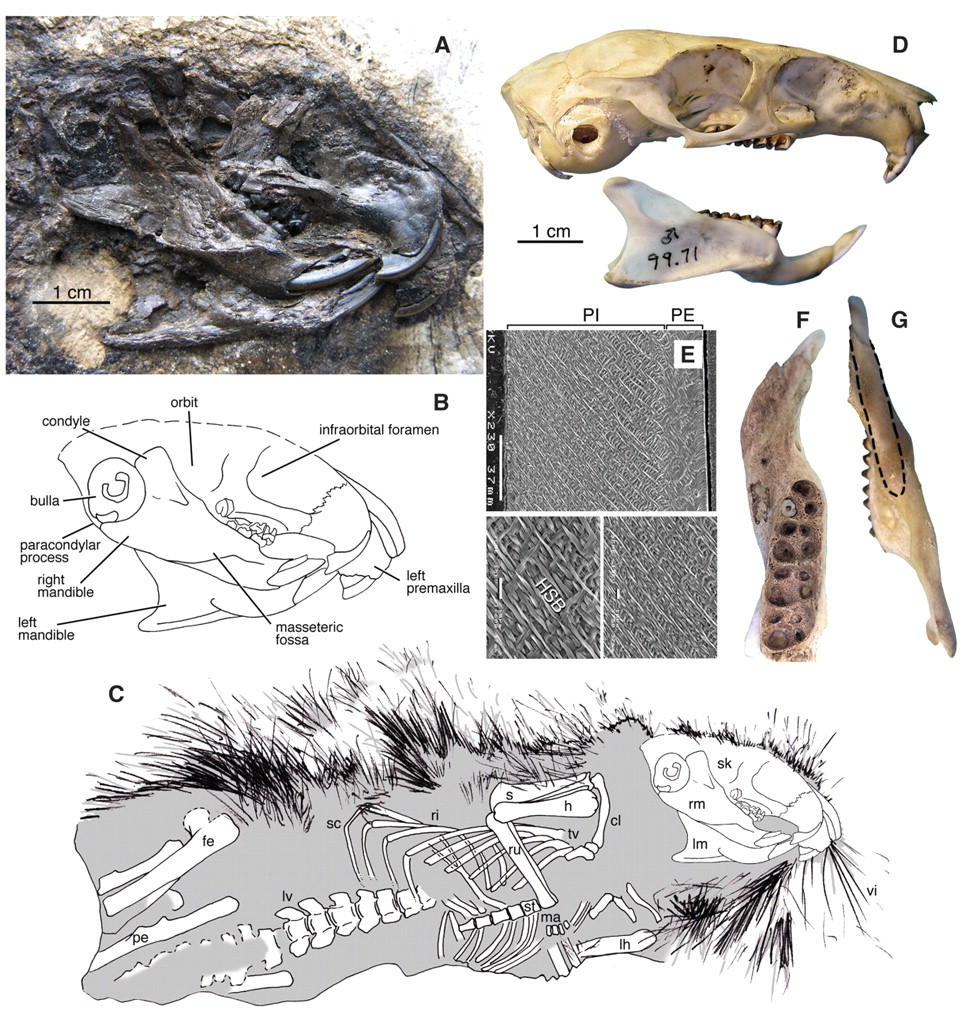
Po srovnání lebky nově objeveného hlodavce se ukázalo, že je to jediný přežívající zástupce skupiny, která byla do té doby známa jen na základě fosílií. Jedná se o čeleď Diatomyidae. Tato skupina je doložena od doby před 32 miliony let do doby před 11 miliony let. Neuvěřitelná díra v našich znalostech o evoluci této skupiny trvající 11 milionů let udělala z hlodavce z Laosu světovou senzaci. Jedná se tedy o nejúžasnější tzv. lazarský druh mezi savci. Tenhle termín označuje organismy, které v určitý čas zmizí z fosilního záznamu, aby se pak znovu objevily. Jak uvádí Dawson et. al., hystrocognátní čelist druhu Laonastes byla v původním popisu nesprávně uvedena a ve skutečnosti má toto zvíře sciurognátní čelist stejně jako fosilní Diatomys. Extrémně zvláštním sdíleným znakem je existence přespočetných kořenů zubů v lícní části. Také stavba skloviny řezáků, separátní neurovaskulární kanál v očnici, humerus s redukovaným deltoidním hřebenem a bez entepicondylárního otvoru a astragalus s krátkým mediálním kýlem jsou znaky podporující zařazení Laonastes aenigmamus mezi Diatomyidae. 

Laonastes má ve skutečnosti sciuromorfní čelist.

Zjednodušené schéma fylogenetických vztahů diatomyidů s geografickým rozšířením vymřelých a recentních forem a se zobrazením zubů v lícní části čelisti z okluzálního pohledu.
Srovnání morfologie Diatomys shantungensis (A, B a C) a Laonastes aenigmamus (D, F a G).

Je velice zajímavé, že diatomyidi se vyvíjeli v izolaci v Asii, zatímco sesterská čeleď Ctenodactylidae zde vymřela a přežila jenom v Africe. Obě čeledi stojí blízko divergenci skupiny Histricognathi, která je recentně rozšířena především v Africe a Jižní Americe. Objev tajemného druhu z Laosu ale naznačuje, že předci této skupiny vznikli v Asii.


Some organisms outlive their relatives for a long, sometimes millions of years lasting time. They become an evolutionary lazaruses. One of such creatures was described only in 2005 and came from Laos. P. Jenkins and coauthors thought, that the new rodent is a member of completely unique family with proposed name Laonastidae (the name of the animal is Laonastes aenigmamus). But as it became clear later, Laonastes is much more than new finding, It is a refugee from times millions ago.

In the first study it was not compared with the fossil rodents. The proposal of its systematic classification was based on analysis of 12S rRNA and Cytochrome b, which indicated Laonastes aenigmamus as a relative of african infraorder Hystricognathi. This group differs from others from order Rodentia in skull anatomy. Muscle masseter medialis goes through infraorbital foramen and ends on both sides of it. The opening os relatively much more big than in other rodents and os zygomaticum is also much narrower. The classification had one important weak point -the absence of morphology.


Comparison of infraorbital foramen of Myomorpha and Hystricomorpha with the depiction of position of muscle masseter medialis. As it beacame clear later,  Laonastes does not belong to any of these groups.

The support for the classification in the discussed study was strong, but later it appeared, that the result was influenced by the long branch attraction and therefore not correct. In 2007 another study with analysis of 4 nuclear and 2 mitochondrial locuses together with the element containing 11 informative locuses (Huchon et. al. 2007) showed, that Laonastes is  a sister clade to family Ctenodactylidae. These are african rodents called gundi and the evolutionary history of this lineage goes to the age 44 millions ago to Oligocene. These data indicate a very old divergence of this enigmatic creature from Laos. It is a lazarus from the age long time ago, which outlived other representatives of its lineage. But what animal is a relative of this animal hidden in the limestone karsts of Laos?


The comparison of skull with fossil rodent showed, that this animal is a last survivor of the group known only from fossils. It is a family Diatomyidae. The oldest discovery is 32 millions years old and the youngest one 11 millions years old. The very long gap in our knowledge of evolution of these rodents is 11 millions years long, so the rodent from Laos caused a true senzation in the scientific audience. It a most striking lazarus species among mammals. This therm is used for organisms, which has vanished from the fossil record and then after some time it appears again. As was published in Dawson et. al., hystricognathous jaw of Laonastes was a wrong interpretation in the first article  and in fact it has a sciurognathous jaw similar to fossil representative of Diatomyidae from genus Diatomys. Extremely strange shared features are supernumerary roots of cheek teeth. Then also a construction of enamel of incisors, separate neurovascular canal in the orbit, humerus with reduced deltoid crest and without entepicondylar opening and astragalus with short medial keel are a characters supporting the classification of Laonastes aenigmamus in the family Diatomyidae. 


In fact, Laonastes has a sciuromorph jaw.
Simplified scheme of phylogenetic relationships of diatomyids with the geographic range of extinct and recent species. There is also a depiction of teeth in the cheek part of the jaw from the occlusal view.
Comparative morphology of Diatomys shantungensis (A, B a C) and Laonastes aenigmamus (D, F a G).

It is very interesting that diatomyids have been evolving in the isolation of Asia, while the sister family Ctenodactylidae went extinct on this continent and survived only Africa. Both families are close to the divergence of Histricognathi, which is recently present mainly in Africa and South America. The finding of the enigmatic species from Laos suggests, that the ancestors of this group can come from Asia.

Zdroje (References):

Jenkins, Paulina D.; Kilpatrick, C. William; Robinson, Mark F. & Timmins, Robert J. (2004): Morphological and molecular investigations of a new family, genus and species of rodent (Mammalia: Rodentia: Hystricognatha) from Lao PDR. Systematics and Biodiversity 2(4): 419-454.

Dawson, M.R.; Marivaux, L.; Li, C.-k.; Beard, K.C. & Métais, G. (2006): Laonastes and the "Lazarus effect" in Recent mammals. Science 311: 1456-1458.

Huchon, Dorothée; Chevret, Pascale; Jordan, Ursula; Kilpatrick, C. William; Ranwez, Vincent; Jenkins, Paulina D.; Brosius, Jürgen & Schmitz, Jürgen (2007): Multiple molecular evidences for a living mammalian fossil. PNAS 104(18): 7495-7499.

Tuesday, October 23, 2012

Seznamte se -nejzvláštnější obratlovci (Meet the weirdest vertebrates of them all)

Pelodiscus sinensis
tvor, který močí přes ústní dutinu (plazi -Reptilia)


(English version at the of the article)

Další článek ze seriálu o nejzvláštnějších obratlovcích pojednává o docela známém tvorovi, nový objev vědců ze Singapuru z něj ale dělá naprostou zvláštnost. Kožnatka čínská je druh patřící do čeledi Trionychidae, která zahrnuje velmi diverzifikovanou skupinu želv s podobnou ekologií. Co je tedy na tomto druhu tak zvláštní? Vylučuje moč nejen kloakou, ale také ústní dutinou a to dokonce v poměru kolem 90 ku 10 %. Vyskytuje se většinou v brakických vodách a je dokonale adaptovaná na akvatický život na dně tůní, odkud občas vyplave na hladinu, aby se nadechla. Co je ale zarážející, tyto želvy v období, kdy tůňky vyschnou, strkají hlavu pod hladinu posledních zbytků nevypařené vody. Důvod byl až dosud záhadou, protože jsou vybaveny standartními plícemi a respirace tedy v tomto chování nehrá žádnou roli.


Po zakoupení několika kusů z místního tržiště a umístění na 6 dní do čistě vodního prostředí se ukázalo, že jenom 6 % procent moči vytvořené v organismu bylo exkretováno přes ledviny. Následně byly želvy přesunuty do suchšího prostředí s možností ponořit hlavu do malých tůní a také tak často činili. Měření množství moči v tůních prokázalo, že je o 50 % vyšší než je tomu u exkrece přes kloaku. Po injekčním vstříknutí moči do těla želv byla její hladina ve slinách až 250 krát vyšší než v krvi a docházelo k častému vylučování přes ústní dutinu pod hladinou vody. Co je tedy důvodem pro takhle složitou exkreci vedoucí z ledvin až do úst? Pravděpodobně to souvisí s prostředím s vysokou koncentrací rozpuštěných solí ve vodě. Živočichové žijící v hypertonickém (s vyšším obsahem rozpuštěných solí) prostředí se potýkají s jedním důležitým problémem -hrozí jim přímá dehydratace, ačkoliv to u vodních druhů vypadá paradoxně. Aby k tomu nedošlo, musejí vypít veliké množství vody s vysokou salinitou a k tomu mít výkonný systém pro odvádění solí ven z organismu. Například u paryb (Chondrichthyes) došlo k adaptaci na toto prostředí tak, že tito obratlovci mají v krvi zvýšený obsah osmoticky aktivních látek, především močoviny. Díky tomu je vnitřní a vnější prostředí u nich poměrně v rovnováze. U kožnatek se tedy podle všeho jedná o stejný problém a vylučování moči přes ústní dutinu pomáhá zefektivnit zbavování se přebytečných solí.


Vylučování močí kloakou vyžaduje mnohem více vody, než je tomu při ústním vylučování. Ta se u kožnatky čínské dostává přes krevní řečiště z ledvin až do ústní dutiny, kde byl objeven gen, který kóduje speciální protein umožňující lepší odvádění moči. Exprimuje se jen v ústní dutině, v ledvinách není přítomen. Je docela možné, že právě tato adaptace umožnila kožnatkám osídlit brakické prostředí, spíše k tomu ale došlo druhotně po vystavení druhu těmto extrémním podmínkám. Studium těchto želv může v budoucnosti také pomoci lidem, kteří prodělali kolaps ledvin. Dnes musejí projít dialýzou, která odstraní přebytečné látky z krve. Pokud by ale bylo možné exprimovat u nich stejný gen, jaký mají kožnatky, bylo by to teoreticky možné provést přirozeně přes ústní dutinu. Jak víme, genetická výbava obratlovců (a nejen jich) má společný základ u společného předka, a tenhle gen by tedy mohl opravdu fungovat i v lidském těle. Na druhou stranu, u kožnatek se v ústní dutině nacházejí struktury podobné žaberním elementům, které savci mají jen v embryonálním stadiu. Přes ně dochází k vylučování moči na principu podobném rybím žábrám. Kožnatka čínská nám v budoucnu zřejmě ještě připraví nějaká nová překvapení.


http://jeb.biologists.org/content/215/21/ii.full.pdf+html


Pelodiscus sinensis
animal, that excretes urine through its mouth (reptiles -Reptilia)


The next article from this series is about a generally well-known creature, but new findings from a Singapore science group puts it a completely different level of weirdness. A chinese softshell turtle belongs to family Trionychidae, which comprises from a very diversified group of species with similar ecology. So what is so special about this species? It excretes urine not only through cloaca, but also through the oral cavity (in 90 to 10 % ratio). The major habitats of these turtles are brackish waters and they are perfectly adapted for an aquatic lifestyle on the bottom of ponds. Only sometimes they have to emerge from water to breath. However, something was enigmatic about these animals. In times, when only some puddles of water remain, they submerge their heads into the water. The reason was discovered recently and it has nothing to do with breathing (turtles have functional lungs). 


After buying of few animals from the local market they were a subject of experiments. 6 days in all-water enviroment showed, that only 6 % of produced urea in organism was excreted through kidneys. Then there was a time spend in drier enviroment with only small puddles of water and turtles really submerged their head there. The measurements of urea levels there proved, that it is higher by 50 % in comparison to excretion through cloaca. After injecting urea into the turtles the level of urea in saliva was 250 times higher than in blood and animals excreted often in the puddles. What can be a reason for such strange behaviour? It is probably related with the enviroment with high salinity. Animals, which live in the hypertonic enviroment (higher level of solutes than in internal enviroment) have one important problem -they face dehydratation, although it seems strange according to water lifestyle. To avoid this, they have to drink a lot of salt water and posess a powerfull system for solutes excretion from their bodies. For example, cartilaginous fishes (Chondrichthyes) have a high amount of solutes in their blood, especially the urea, which is an adaptation for balancing their level coming inside with water. The two enviroments are therefore in equalised. In softshell turtles it is therefore a same issue and excretion of urea through mouth helps to ged rid of waste solutes.


The excretion through cloaca demands a lot more water than the way done on the other side of the body. The water travels through the bloodstream from kidneys to the oral cavity. Scientist have found a gene, which encodes a special protein allowing a better excretion of urea. It is expressed only in the mouth tissue (not in kidneys). It is possible, that this adaptation allowed chinese softshell turtles to colonize the brackish waters, but more probable is a hypothesis, that they have adapted secondarily to this enviroment. Study of these turtles is a promise for people, who have undergone the kidney collapse. Today are dependent on dialysis, which removes the waste from blood. But if there was a possibility to express the same gene, which is expressed in turtles, it will be theoretically real to excrete the urea through mouth. As we know, the genetic material of vertebrates (and not only them) has a common origin, so this gene could be also working in the human body. On the other hand, there are a structures similar to gill elements present in the oral cavity of softshell turtles and the excretion of urea is based on principle functioning in fish gills. Such structures are possesed just by the embryonal stages in mammals. The study of Pelodiscus sinensis can possibly reveal many new surprises for science.


Tuesday, August 21, 2012

Seznamte se -nejzvláštnější obratlovci (Meet the weirdest vertebrates of them all)

Při své výzkumné práci, která je věnovaná netopýrům, jsem narazil na tvora, který by pro většinu lidí představoval něco krásné a zároveň odpudivé. Ano, je to netopýr a všichni víme, jaký je obecný názor na tato zvířata. Při pohledu na druh Kerivoula picta by ale mnozí svůj názor snad změnili -je to netopýr v rouše motýlím.


 Kerivoula picta
motýlí netopýr (savci -Mammalia)


(English version at the end of the article)

Za pestrobarevným netopýrem je nutné se vydat do jižní a jihovýchodní Ázie, konkrétně do Indie, Srí Lanky, Nepálu, Vietnamu, Malajzie nebo Indonézie. Typickým biotopem jsou suché lesy. V tomhle ekosystému je ale poměrně málo úkrytových možností pro ekologickou niku, jakou zastávají netopýři. Ze živočišné říše známe mnoho příkladů toho, že pestré zbarvení, které nám připadá jako pěst na oko, může v přirozeném prostředí zvířete sloužit jako dokonalé maskování. Něco podobného pravděpodobně vedlo i k evoluci netopýra Kerivoula picta, kterému slouží jeho zbarvení k tomu, aby rozbilo opticky jeho obrysy a predátoři ho během klidových stavů neobjevili. Přes den vyhledávají nejrůznější úkryty, které se dají využít, jako například hnízda snovačů nebo strdimilů, veliké listy stromů a střechy místních domů. 

Co se týče úkrytové strategie, je tenhle druh tedy odkázán na schopnost najít ty nejefektivnější místa a jedinci s pestřejším zbarvením znemožňujícím jejich nalezení během slunečného dne byli pravděpodobně zvýhodněni a lépe přežívali. Své geny předali dál budoucím generacím. Výsledkem je oranžovočerné zbarvení, které v úkrytu, kam prosvítají paprsky tropického slunce, dokonale chrání spícího netopýra před zraku dravců.


V jiných ohledech je Kerivoula picta typickým netopýrem využívajícím pro lov a orientaci v prostoru během noci echolokaci stejně jako několik dalších druhů tohoto rodu z Asie. Srst je vlnatá a slouží pro termoregulaci. Tito netopýři nežijí v koloniích, které pro svou existenci vyžadují dokonale bezpečné místo pro shromažďování. Naproti tomu rodiče žijí se svými mláďaty a ty si po osamostatnění najdou vlastního partnera. O rozmnožovacím chování tohoto druhu se ale neví kromě této informace nic, což je vědeckou výzvou do budoucnosti. Evoluční strategie tohoto netopýra totiž rozhodně není mezi letouny běžná. 


Podívejte se, jak se hledá úkryt motýlího netopýra:


During my scientific work, which is focused on bats, I came across the creature beautiful and scary at the same time. Yes, it is a bat and we all know, what kind of attitude the majority of people have towards them. But when you look at Kerivoula picta, you should definitely change your mind -this is the bat in butterfly's clothing.


 Kerivoula picta
bat in butterfly's clothing (mammals -Mammalia)


To find this multi-coloured bat it is necessary to travel to South and Southeastern Asia. It can be found in India, Sri Lanka, Nepal, Vietnam, Malaysia or Indonesia. The typical habitat is dry forest, which is an ecosystem with quite a few options for finding shelter in bat ecological niche. From the animal kingdom we know many examples of bright coloring, which seems to us like a fist on the eye, but in the natural environment of the animal it serves as the perfect camouflage. Something similar probably also led to the evolution of Kerivoula picta. Its colour visually breaks the outline of the body and it makes this bat to be hardly found by predators during the resting periods. During the day, it seeks a variety of shelters, which can be used, such as nests of weaver finches or sunbirds, large leaves of the trees and the roofs of local houses.

This species is therefore dependent on the ability to find the most effective shelters and individuals with more bright colouring
were probably better in preventing their finding during sunny days and it gave them an advantage, so they survived and passed their genes to next generations. The result is an orange and black color, which protects the bat in the shelter, where the tropical sun rays shine and it is almost impossible for predators to find it.


In other aspects, Kerivoula picta is a typical bat using echolocation for hunting and orientation in the darkness similarly to other members of this genus from Asia. Its fur is wooly and is important for thermoregulation. These bats don't live in colonies, because such lifestyle needs a perfectly safe place for its members. Instead, parents live with their offspring till they find their own partners. This is the only information about the reproduction of Kerivoula picta, so the future field work on this topic is a big temptation. The evolutionary strategy of this bat is really interesting and it is nothing usuall among members of Chiroptera. 


Watch the video showing the shelter of butterfly bats here:
http://www.youtube.com/watch?v=cMTBh0TZ-cs

Friday, July 20, 2012

Seznamte se -nejzvláštnější obratlovci (Meet the weirdest vertebrates of them all)

Tak jako všechny vědecké směry, i zoologie potřebuje dobrou popularizaci. Asi nejlepší formou je ukázat ty nejzajímavější, nejpodivnější a pro širokou veřejnost nejsympatičtější objekty zájmu, a právě tenhle seriál bude takovou přehlídkou. Samozřejmě, že těch nejzvláštnějších obratlovců!

 
Neoclinus blanchardi
Agresivní mistr obrany (ryby paprskoploutvé -Actinopterygii)


(English version at the end of the article)


Když se ponoříte pod hladinu Tichého oceánu na pobřeží Kalifornie nebo státu Baja California v severním Mexiku, možná narazíte na rybu Neoclinus blanchardi. Dorůstá jen do délky 30 cm a žije v blízkosti úkrytů a skal, kde si brání agresivně své teritorium před soky z řad svého druhu, ale také před predátory a narušiteli. Pro život u dna má přizpůsobený tvar těla se silnými pektorálními ploutvemi, redukovanými ventrálními a dlouhým ploutevním lemem kolem zadní části těla. Často využívají k úkrytu štěrbiny nebo opuštěné schránky mořských živočichů. Na bocích má tenhle druh redukované šupiny. Na první pohled tedy žádná extrémně podivná ryba. Z fylogenetického pohledu ji řadíme do skupiny Perciformes (ostnoploutví), což je pravděpodobně parafyletická skupina a zároveň největší řád mezi obratlovci (kolem 160 čeledí).

Co je tedy tajnou zbraní této ryby? Obří tlama. Využívá zastrašujícího chování, kdy si živočich v obraně díky speciálně uzpůsobeným strukturám hraje na většího a hrozivějšího, než ve skutečnosti je. Takových příkladů je v živočišné říši dost. U ryby Neoclinus blanchardi ale jde především o nástroj pro vnitrodruhovou teritorialitu. Sama o sobě je natolik agresivní, že většinu nepřátelů odežene z teritoria i bez použití tohoto triku. Samci ale spolu vždy bojují právě takhle. Podívejte se teď, o co ve skutečnosti jde.


Tušíte, jakým způsobem dokáže tahle ryba roztáhnout tlamu do této extrémní pozice? Odpověď jsem našel v anatomii čelistí. Kosti praemaxillare a maxillare jsou extrémně prodloužené, což si můžete všimnout už na první fotografii, kde je ryba v klidové pozici. Na obrázku vpravo je zobrazení běžných proporcí těchto kostí k ostatním na lebce u kostnatých ryb (Teleostei). Vyobrazení lebky tohoto druhu jsem neobjevil, ale podle fotografií živých zvířat je zřejmé, že dentale a articulare (kosti na spodní čelisti) nadměrných rozměrů nedosahují, naopak jsou spojeny s horní čelistí pomocí kožního lemu a slouží jako stabilizátor čelistí v extrémní poloze při souboji. Z evoličního hlediska má tahle modifikovaná čelist zamezit mortalitě při vnitrodruhové kompetici o teritorium. Jedná se zde o trend evoluce, kdy není cílem soků se navzájem zabít, ale jenom zjistit v ritualizovaném souboji, kdo je silnější. Něco podobného vidíme třeba u paroží jelenů. Samci ryby Neoclinus blanchardi se navzájem přetlačují s roztaženými tlamami a silnější z nich získá právo na dané teritorium. Na závěr nejlepší snímek této ryby, který je opravdu fascinující. Až se budete jednou potápět na pobřeží Pacifiku v inkriminované oblasti, hledejte tohoto podivuhodného bojovníka.

 
Podívejte se na video bojujících ryb Neoclinus blanchardi:
https://www.youtube.com/watch?v=SW-lmTLrl6U


Same as in other scientific fields, also the field of zoology needs a good popularization. The best form of this is to show the most bizarre, most interesting and most beloved creatures for vast majority of people and this series will provide exactly these features. Prepare yourself for the portion of the amazing vertebrates!

Neoclinus blanchardi
Agressive master of defense (ray-finned fishes -Actinopterygii)


If you dive under the surface of water in the Pacific ocean on the coast of California or state Baja California in Mexico, you may come across the fish called as sarcastic fringehead (Neoclinus blanchardi). It is only 30 cm long and lives near the rocks and various shelters, where it defends agressively its territorium against enemies from the same species, but also every other intruder. It is adapted for the life near the sea floor -it has strong pectoral fins, reduced ventral fins and a single ribbon is running along the distal part of the body. They usually use a shells and holes in rocks as shelters. The scales on the lateral sides of the body are reduced. So, for the first glance nothing special as a fish. From the phylogenetic point of view it belongs to Perciformes, which is probably a paraphyletic group and also the biggest order of vertebrates with approximately 160 families.

So what is the secret weapon of this fish? A huge mouth. It uses an intimidation behaviour and tries to look bigger and more fearsome than it actually is. We know many examples of this technique in animals. But in Neoclinus blanchardi it is mainly the instrument used for the fights for territories in intraspecific scale. This fish is generally so agressive, that most of the possible threats are successfully driven off without this trick. On the other side, males compete only in this amazin way. Let's look on what it actually represents.


Do you have any idea, how can this fish spread its mouth so widely? I found the answer in the anatomy if its jaws. Bones praemaxillare and maxillare are extremelly elongated, as you can see already on the first photograph, where the animal is in resting position. On the picture to the right you can see the usuall proportions of these bones compared to other bones of the skull in Teleostei. I couldn't find the actuall photo of the skull of this species, but from the photograph of living individuals you can see, that dentale and articulare (bones of lower jaw) are not elongated, so they serve as a stabilizer of jaws in extreme positions during fights and are connected with upper jaw by elongated skin. From the evolutionary point of view, this modified jaw is a feature, that should erase the intraspecific mortality in individuals competing for territory. The aim is not to kill, but only to show the power and win. Something similar is the evolution of deer antlers. Males of Neoclinus blanchardi are pushing against each other with widely opened mouths and only the stronger one will have the territory. At the end look at the best picture of this fantastic fish. If you will be diving on the Pacific coast sometime, you should try to find this amazing fighter.


Watch a video of fighting sarcastic fringeheads:
https://www.youtube.com/watch?v=SW-lmTLrl6U